Before You Bid: The Four Registrations Required for DLA Contracts
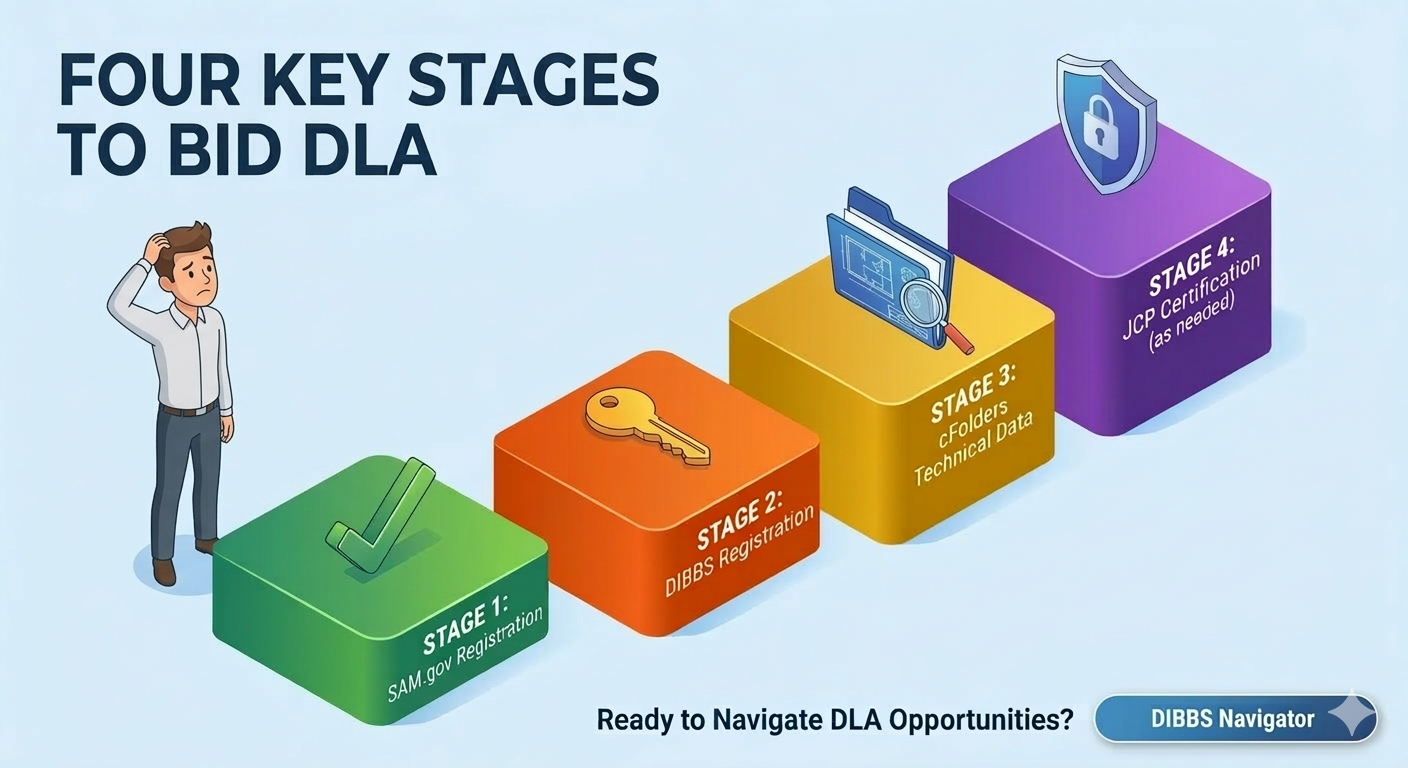
The U.S. federal government is the largest buyer of goods and services in the world. For manufacturers, that represents a significant opportunity — steady demand, repeat purchasing, and long-term customers.
That opportunity is real. But gaining access requires navigating multiple registration systems and approval layers.
Many manufacturers assume that once they register in SAM, they’re ready to begin bidding. In reality, SAM registration is only the first step in a multi-layer process.
If you plan to pursue Defense Logistics Agency (DLA) solicitations through DIBBS, you’ll encounter several separate systems — each designed for a specific purpose and each required before you can fully participate.
Understanding how these pieces fit together is the difference between chasing opportunity and positioning yourself to compete for it.
The process begins with the system that establishes your company in the federal marketplace.
1. SAM Registration and Your CAGE Code
Every company that wants to sell directly to the federal government must register in SAM.gov.
Once registered, you receive:
A Unique Entity ID
A CAGE (Commercial and Governmental Entity) code
This step is mandatory. It formally establishes your company in the federal system.
However, SAM registration alone does not allow you to submit bids on DLA solicitations.
To actually compete for DLA contracts, you must register within DLA’s own bidding platform.
2. DIBBS Registration
DIBBS (DLA Internet Bid Board System) is where bids are submitted to DLA.
Even if your company is active in SAM, each individual user must register in DIBBS under your company’s CAGE code.
The first person to complete registration under a CAGE becomes the “Super User.” That individual controls access for others within the company and must approve additional users.
Registration involves identity verification and address confirmation. Until this process is completed, your company cannot submit bids electronically.
This is often where companies discover that someone previously registered under their CAGE — or that access must be re-established if a Super User has left the organization.
Once registered in DIBBS, another layer becomes relevant when technical data is involved.
3. cFolders (Technical Data Access)
Many DLA solicitations include detailed Technical Data Packages (TDPs). These may contain drawings, specifications, standards, and procedures that define exactly what must be delivered.
Those documents are typically accessed through cFolders, a separate DLA collaboration system.
Access to cFolders requires:
An active DIBBS account
Separate login credentials
Proper authorization under your company
Without cFolders access, you may be able to view a solicitation notice — but not the full technical requirements needed to prepare an accurate bid.
For certain items, one additional approval may also apply.
4. JCP Certification and Controlled Technical Data
For solicitations involving critical or controlled technical data, Joint Certification Program (JCP) approval may be required.
JCP registration now occurs through an online portal and may involve documentation related to cybersecurity compliance, including a NIST SP 800-171 self-assessment score recorded in SPRS (Supplier Performance Risk System).
This step is not required for every solicitation. But when it is, it becomes a gatekeeper for accessing sensitive technical data and participating in that opportunity.
Where Companies Get Stuck
Most frustration in federal contracting does not come from writing bids. It comes from navigating layered registration systems and access controls.
Common obstacles include:
Discovering a prior Super User who no longer works at the company
Delays in identity verification
Password or account lockouts
Inability to access technical drawings
Uncertainty about whether JCP approval is required
Many third-party services offer to complete these registrations for a fee. However, these systems are free to use, and companies must still provide their own information and documentation during the process.
Registration is necessary — but it is not the finish line.
Registration Gets You Access — Not Strategy
Clearing these four gates gives you the ability to participate.
It does not answer the next set of questions:
Which solicitations align with your manufacturing capabilities?
What similar contracts have historically sold for?
Who are the repeat buyers?
How often does DLA purchase a given item?
Are you likely to be competitive?
That’s where many new suppliers realize the real challenge begins.
Registration gets you into the system. Insight helps you compete within it.
If you’re already registered — or close to it — DIBBS Navigator was built to help manufacturers filter, evaluate, and track DLA opportunities with greater clarity. You can explore the platform with a 30-day trial and see how it fits into your bidding process.